Friday, December 16, 2022

"Different perspective about this picture of an eagle and a snake"Initiator: Mrs. Ruchi Jain

Our discussion today on the topic 

"Different perspective about this picture of an eagle and a snake"
Initiator: Mrs. Ruchi Jain

View 1: Mrs. Sangeetha Thyagarajan

The picture seems confusing and makes us wonder who's hunting whom.

Looks like the eagle was carrying the snake and the snake wound itself around the eagle, forcing it to land and get its bearings.

The eagle needs to reinstate its supremacy even though it flattered due to carelessness.

View 2: Mrs. NAMAGIRI

Eagle represents honesty,truth,all that is good.But a snake represents evil and sin. The eagle does not have battle with the snake in the ground.It takes up ,flies high and wins as it has no strength in the air.

View 3: Mr. Priyank Jain

In my view where the eagle is eager for his fooding and hunting the snake but the snake is just not saving himself but he is attacking on the eagle. This picture is not declaring the winner. It may eagle or snake. Because the snake may crack eagle backbone any time where the eagle is in over confidence.

View 4: Azeez

Garuda how are you? asked for the snake from Paramashiva's neck

Garuda said that everything is better if it is taken from where anyone is.
It also has meaning.

The public in high places will respect you. Even your shadow will not respect you if you are down

Don't step on disrespecting people's threshold, Awwayyar said to the honorable man. It has meaning in what it said

A cart needs only two wheels to run. If one of the two is smaller then which car will run. Just like you, you should treat yourself in moderation. Relationship between superiors and inferiors. It means smallness
(Cinelyric written by the tamil poet KANNATHASAN)

The snake represents the Ahamkara (ego). When we poke a snake, it recoils instantly and spreads its hood to attack us. Similarly, when someone says something that we don't wish to hear, our ego spontaneously reacts. This ego lies inside the human body whereas, in the Gods and the Goddesses, the ego becomes powerless. It doesn't affect them because they govern it. Hence, Shiva uses this Ahamkara as an ornament because it doesn't find space within his body.

• OUR CREED AND AIM.
Eagle and Snake

A race of altruists is necessarily a race of slaves.
A race of freemen is necessarily a race of egoists.
Freedom cannot be granted. It must be taken.

To convert the exploiters to altruism is a fatuous programme–a maniac’s dream. The only remedy for social injustice is this: the exploited must save themselves by enlightened self-interest. The exploiters are certainly egoistic enough; the only hope for the exploited is for them to become equally so–yes, consistently, persistently egoistic. 

Egoism spells justice and freedom as surely as altruism spells charity and slavery.

O EXPLOITED PEOPLES! EXCEPT YE ARE CONVERTED AND BECOME AS PROUD AS THE EAGLE AND AS WISE AS THE SERPENT, YE SHALL IN NO WISE ENTER INTO THE KINGDOM OF JUSTICE.

• Do eagle eat snakes? 
No.

Snakes are carnivores, so they do eat other animals. They would not eat an eagle, though, because they wouldn't be able to catch one. Eagles are apex predators, at the top of the food chain. They have no natural predators except man. A snake may scavenge a dead eagle, but is unlikely to hunt a living one.

Still they fight for life. It is not a fight to save their life, it is a conversation between their lives.

View 5: Mrs. Abrar Khan

From nature, we can learn few values. From the picture,

1. We need to defend ourselves when it is required. 
2. Ego can destroy us.
3. Eagle has the ability to hold and fly, here the present world few people telling lies they try to fly. But they are not aware that God is watching. 
Even eagle has to come down with the prey.

So, with showing the picture we can ask the students to speak their views on values. This activity can be done for moral values.

View 6: Nahid Raza

Each creature has its own strength. When someone attacks it. It responds with it's strongest point. Both the players play with their strength. They know when to attack and when to defend. Their wiring of brain is such. Eagle was devastating sure to make the snake its prey due to its flight and grip along with its pointed and powerful beak. Flight gives it freedom to rule in the air. But snake fights with everything it has. It has immense capacity to coil and crush the Eagle to clot the flow of blood. Nature has its own way.

Eagle knows where to make grip. Hence it may be difficult for the snake to get rid of. Still nature has its own role to play.

Thursday, December 15, 2022

Honouring students' diversity in a classroom

Topic: Honouring student diversity in classroom.

1. Knowing the Learner

Teachers must make every effort to know learners in order to meet their diverse needs. Just as clothing designers must know about the many fabrics and styles to create a garment to suit the wearer, so in classrooms we teachers must know about our learners so that we may “design” learning to meet their needs.

How do you get to know your students?

• What kinds of things do you seek to learn about? 

• What methods do you use? 

• How might you use this information?

¶ Steps to know a child in your classroom

Think of ONE student in your classroom.

How would you describe him/her?

On what base would you describe?

Where would you get data of the child from and what mode/tool you used to describe him/her?

Now.. 

3 Things you learned

• Source to collect data
• Tool to analyse dats
• Describing/Knowing the child

Knowing the students:

Source:

• Learning Styles
• Thinking Styles
• Multiple Intelligences

Tools used:  Using ASSESSMENT
as a means for describing and to inform.

Every time I talk to the children I am learning about them. I like the words learning about much more than I like assessing. I learn about my children, I get to know them. I want to know what they know. I want to know how they know. 

Isn’t that what assessment is all about – learning what children know? 

Why wait until the end of the receiving complete data to assess, when listening, observing, and asking questions along the way will give us so much more information about them and to inform our instructions. 

We need to establish routines that afford us opportunities to assess in the context of authentic experiences of our own.  If we watch and learn from our students while they are in the process of learning and living in the classroom, we can use that information to plan instruction more effectively.

Our description should include the environment he/she lives and loves, emotional bonds with peer groups/teachers/classmates/schoolmates, academic performances and social differentiation that will be in place to meet the needs of content area in which the candidate is the sample.
[The above source is to assess his/her  learning style and thinking style]

Independent Study – Using an internet resource, text, comprehension, preparing memory map/mind map, develpoping creative questions or a periodical, brain-based learning, mind games....can be used as a source to assess multiple intelligence.

From here begins the differentiation. How to address individual differences? What are those differences and how will honour these diversities in students?

Diversities are in:
[Teacher's Role is to know..]

1. INDIVIDUAL STYLES OF LEARNING AND THINKING

2. GIFTED AND TALENTED STUDENTS
• Identifying gifted and talented
• Knowing their qualities
• Supporting them

3. GENDER DIFFERENCES IN THE CLASSROOM
• Physical differences in gender roles
• Social differences in gender roles
• Academic and cognitive differences in gender
• Attention paid
• Public talk versus private talk
• Distributing praise and criticism

4. DIFFERENCES IN CULTURAL EXPECTATIONS AND STYLES
• Bilingualism: language differences in the classroom
• Balanced or fluent bilingualism
• Unbalanced bilingualism
• Language loss
• Cultural differences in language use
• Cultural differences in attitudes and beliefs

5. TAKING A LOOK AT THE OPPORTUNITY GAP
6. ACCOMMODATING DIVERSITY IN PRACTICE

Conclusion:

1. Students differ in a multitude of ways, both individually and as groups. Individually, for example, students have a preferred learning style as well as preferred cognitive or thinking styles. They also have unique profiles or intelligence or competence that affect how and what they learn most successfully.

2. In addition to individual diversity, students tend to differ according to their gender, although there are numerous individual exceptions. 

Motor abilities as well as motivation and experience with athletics gradually differentiate boys and girls, especially when they reach and begin high school. 

Socially, boys tend to adopt relationships that are more active and wide-ranging than do girls. 

Academically, girls tend to be a bit more motivated to receive slightly higher marks in school. 

Teachers sometimes contribute to gender role differences— perhaps without intending—by paying attention to boys more frequently and more publicly in class, and by distributing praise and criticism in ways differentiated by sex.

3. Students also differ according to cultures, language, and ethnic groups of their families. 

Many students are bilingual, with educational consequences that depend on their fluency in each of their two languages. 

If they have more difficulty with English, then programs that add their first language together with English have proved to be helpful. 

If they have more difficulty with their first language, they are risk for language loss, and the consequences are also negative even if more hidden from teachers’ views.

Other diversities like health, economy, and family set up...in students' life are immaterial in a classroom setup because these are welknown in public and not sensitive as other diversities stated above. Also we can have material proofs for these issues like court order, medical report , autopsy....

And these issues ofcourse cause damages to individulas and not as whole.

தமிழ்

Steps to know a child in your classroom

• Sonal Kathuria - UN Educationist

This year we made a form that was given to the parents and they had to fill. The form included questions like favourite pass time, favourite activity, food, allergy, sport a lot more. 
The teachers collected the form on the first day of school and with the information shared by the parent it was so helpful and easy to take care of our young learners. This also made the parent feel that we are concerned about small small things about the child and it really helps.

We also share a medical detail form for all sort of medical Information needed. 

A list of documents to know the date of birth, place etc.

உங்கள் வகுப்பறையில் ஒரு குழந்தையை அறிவதற்கான படிகள்

 • சோனல் கதுரியா - ஐ.நா கல்வியாளர்

இந்த ஆண்டு பெற்றோருக்கு வழங்கப்பட்ட படிவத்தை நாங்கள் செய்தோம், அவர்கள் பூர்த்தி செய்ய வேண்டும்.  ஃபேவரிட் பாஸ் டைம், ஃபேவரைட் ஆக்டிவிட்டி, உணவு, அலர்ஜி, விளையாட்டு போன்ற பல கேள்விகள் படிவத்தில் இருந்தன.
 பள்ளியின் முதல் நாளில் ஆசிரியர்கள் படிவத்தை சேகரித்தனர், மேலும் பெற்றோரால் பகிர்ந்து கொள்ளப்பட்ட தகவலுடன், எங்கள் இளம் மாணவர்களைக் கவனித்துக்கொள்வது மிகவும் உதவிகரமாகவும் எளிதாகவும் இருந்தது.  இது குழந்தையைப் பற்றிய சிறிய சிறிய விஷயங்களைப் பற்றி நாங்கள் கவலைப்படுகிறோம் என்று பெற்றோருக்கு உணரவைத்தது, அது உண்மையில் உதவுகிறது.

தேவையான அனைத்து வகையான மருத்துவ தகவல்களுக்கான மருத்துவ விவரப் படிவத்தையும் நாங்கள் பகிர்ந்து கொள்கிறோம்.

பிறந்த தேதி, இடம் போன்றவற்றை அறிய ஆவணங்களின் பட்டியல்.
தமிழ்

Honouring student diversity

• Sangeetha Thyagarajan - UN Educationist

Diversity amongst students generally refers to the differences between them based on

1. Religion, caste , greed
2. Region, language
3. Social standing
4. Mental abilities and capabilities 
5. Age, sexual orientation 
6. Physical capabilities. 

But, in schools we only consider the first one as a case of student diversity.
To abate discriminations we encourage 

- cultural and religious celebrations in school.
- respect for all languages and castes/religions with competitions based on their culture. 
-  holidays during their celebrations. 
- teaching them about the constitution and their rights.
- being fair and just to all students. 

The difference in social standing, mental and physical capabilities and sexual orientation still need deep rooted methods to handle.

Though we talk of inclusive education,  its only a partial solution to a ice-berg problem. 

So, lets continue honouring students in the way we know best by ACCEPTING THEM AS THEY ARE and HELPING THEM GROW into sensitive,  productive individuals.

மாணவர்களின் பன்முகத்தன்மைக்கு மதிப்பளித்தல்

 • சங்கீதா தியாகராஜன் - ஐ.நா கல்வியாளர்

மாணவர்களிடையே உள்ள பன்முகத்தன்மை பொதுவாக அவர்களுக்கு இடையே உள்ள வேறுபாடுகளை அடிப்படையாகக் கொண்டது

 1. மதம், சாதி , பேராசை
 2. பகுதி, மொழி
 3. சமூக நிலைப்பாடு
 4. மன திறன்கள் மற்றும் திறன்கள்
 5. வயது, பாலியல் நோக்குநிலை
 6. உடல் திறன்கள்.

ஆனால், பள்ளிகளில் நாம் மாணவர்களின் பன்முகத்தன்மையின் நிகழ்வாக மட்டுமே முதல் ஒன்றைக் கருதுகிறோம். பாகுபாடுகளைக் குறைக்க நாங்கள் ஊக்குவிக்கிறோம்

 - பள்ளியில் கலாச்சார மற்றும் மத கொண்டாட்டங்கள்.
 - அனைத்து மொழிகள் மற்றும் சாதிகள்/மதங்கள் தங்கள் கலாச்சாரத்தின் அடிப்படையில் போட்டிகளுடன் மரியாதை.
 - அவர்களின் கொண்டாட்டங்களின் போது விடுமுறை.
 - அரசியலமைப்பு மற்றும் அவர்களின் உரிமைகள் பற்றி அவர்களுக்கு கற்பித்தல்.
 - அனைத்து மாணவர்களுக்கும் நியாயமாகவும் நியாயமாகவும் இருத்தல்.

சமூக நிலை, மன மற்றும் உடல் திறன்கள் மற்றும் பாலியல் நோக்குநிலை ஆகியவற்றில் உள்ள வேறுபாட்டைக் கையாள இன்னும் ஆழமான வேரூன்றிய முறைகள் தேவை.

உள்ளடக்கிய கல்வியைப் பற்றி நாம் பேசினாலும், பனிப்பாறை பிரச்சனைக்கு இது ஒரு பகுதி மட்டுமே தீர்வு.

எனவே, மாணவர்களை அவர்கள் இருக்கும் நிலையில் ஏற்று, உணர்வுப்பூர்வமான, உற்பத்தித் திறன் கொண்ட நபர்களாக வளர உதவுவதன் மூலம், நமக்குத் தெரிந்த விதத்தில் மாணவர்களை கௌரவிப்பதைத் தொடரலாம்.
Steps to know a child in your classroom.

Mrs Abrar Khan - UN Educationist

We have one to one mentor meet where we are close to students and exchange views. 

After 3 or 4 session they are free with the mentor and open up. We understand their difficulties:

• Broken families 
• Writing difficulties 
• Speaking in public 
• Memory power
• Exam fever  

We understand the problem send as per that we tackle and it has really helped us in  bringing the effects
successfully.

The parents are mostly worried about academic. Of course few are worried about all round development. 

This mentor session is helped in developing the confidence in students and sucess in their careers.

I have received many calls even after the marriage. They remember the shaping of their career. I am sure many of us

Wednesday, December 14, 2022

What kind of attitudes can we learn from learning languages?

Topic for our discussion:

What kind of attitudes can we learn from learning languages?

Initiator: Dr. Tarun
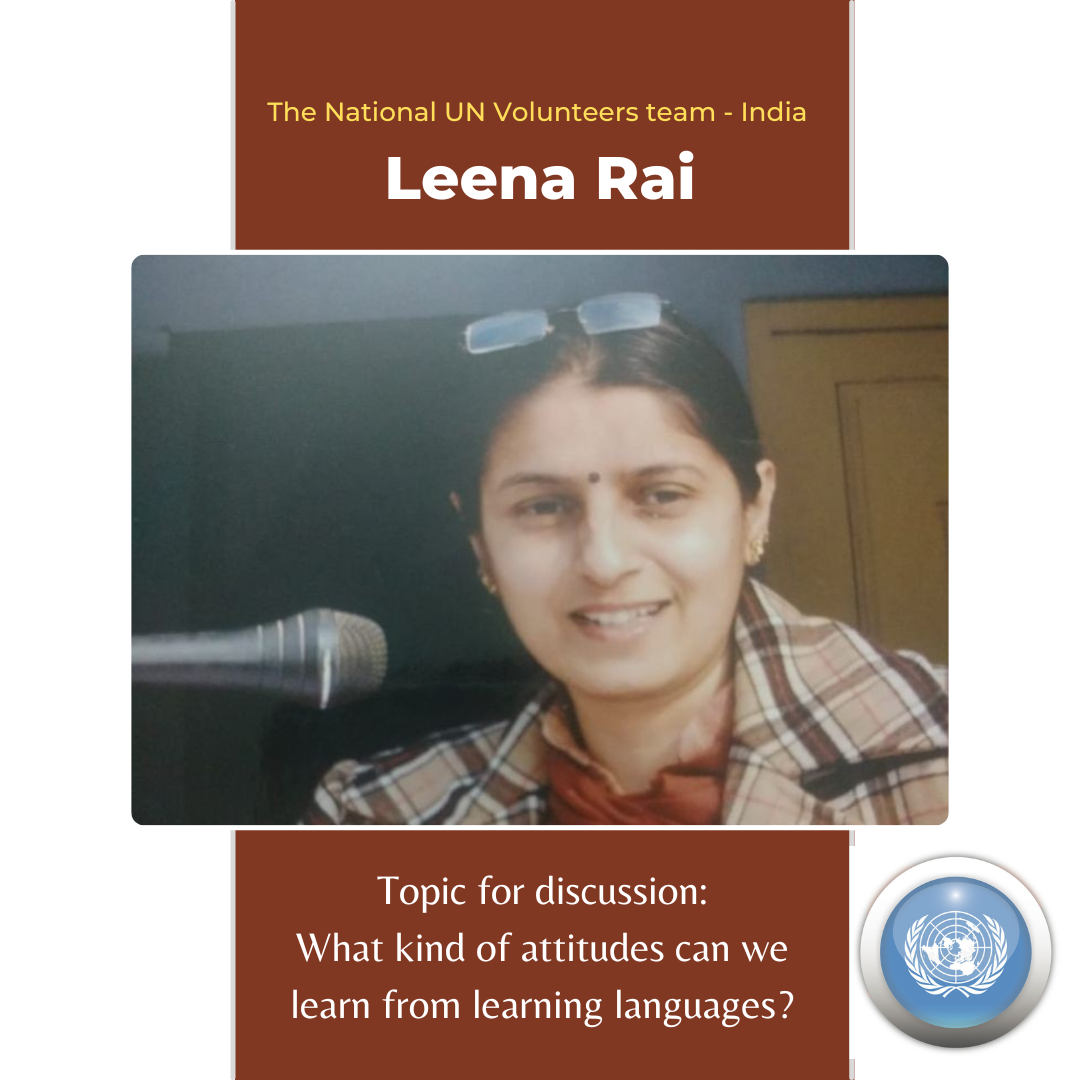
View: Leader: Leena Rai || UN Educationist

Language is never a barrier but an open arena to express, to communicate and to give voice to voiceless.

Therefore, it's not a language of alphabets, word formation but a whole lot of cultural diversity which can result into the feeling of:
• Morality 
• Respect
• Unity
• Dreaming
• Culture
• Co-operation 
• Leadership
Team building 
Conversant
Visionary pathway to success 
Breaking barriers etc
Topic for our discussion:

What kind of attitudes can we learn from learning languages?

Initiator: Dr. Tarun
View: Mrs. Ruchi Jain  || UN Educationist

Learning language is a great opportunity to inculcate the values and skills in a person or ourself.  When you start learning a new language  you start acting like a River, which moves according to the passage,  takes all new things with it, making its way down with out stopping anywhere and so on. We can list those all qualities down as follows:

1. Empathy - Learning language can built the ability to understand and share.
2. Patience - Language learning requires alot of patience for a long time and one has to be ready for the critical feedback as well.
3. Integrity - One has to have the attitude of Integrity as you are welcoming all new words and impression in your expression of thoughts.  It reflects the behavior too.
4. Versatile - Knowledge of different languages makes you Versatile in terms of speaking,  it builds your Versatile nature too, where you make yourself ready to act out on account of gaining more.
5. Acceptance - Wherein language requires to be learnt when you are ready to accept all new words , letter and so on , as a river do. This new quality adds on to your attitude towards people as well .
6. Endurance - On receiving the critical feedback from the language  facilitator, the learners have to endure what so ever is feedback is , with positive attitude.  This attitude helps them further in their social and personal involvement to act wisely. This behavior is just similar to an athlete too who endures all the pain to gain.
7. Broader outlook - Of course learning language couldn't leave you with out making your outlook Broader,  when you are absorbing all new ideas , words,  letters , values , the regional impression of that language and  so on. Just like a river , when other water bodies get added to the main stream it becomes a larger one in itself and requires a broader space to flow. 

Thus, Learning language is a complete and a complex journey in itself like a river has its journey.  The adaptation makes you empowerd with a new language,  which helps you to grow like a strong person with holistic development.
🍁

Dr. Tarun: Thanks for sharing. But, I am not sure if language learning has built me to be more empathetic or I have not learnt the language properly.
🍁

Mrs. Ruchi Jain: There is nothing wrong in having different views. We all have different perspectives.  For me '9' it's a nine, but for other person it's a six. We would like you to pour out your views as well about language learning experiences and developed attitude by it.
Topic for our discussion:

What kind of attitudes can we learn from learning languages?

Initiator: Dr. Tarun
View: Mrs. Nilowfer Khan || UN Educationist

Learning different languages is stepping stones of success. Students    are fastinate to learn. 

They want to speak with their peers to expose themselves. All the values they adopt as they learn. Specially in our country we are blessed with many languages. 

The students who come from abroad, they value the morals and practice. Our native students are blessed with this.

Also if they find particular language is easy  they understand the concepts and explain in their own words.

Language lab is really an attractive place as of science lab.

They enjoy the theatre the most and now it is a part of NEP. 

Since the students come from different areas they also explore to learn the skills by speaking the language. 

Also all the four skills which is required for all the subjects are developed. Hence learning any language is will make every one to explore and helps us  grow .

Topic for our discussion:

What kind of attitudes can we learn from learning languages?

View: Mrs. Archna || UN Educationist

Proficiency in different languages not only open up new doors but also works as the vital skill to engage with the world in more creative and better way.

Some of the benefits i feel learning different languages  are:

1.  Increase cultural awareness- it brings us closer to other culture and brings open mindedness.
2. High cognitive abilities - many researches are being done on people with multilingual abilities connecting it to higher cognitive abilities.
3. Creative thinking capacity- It enhances creative thinking ability by understanding things in native language and visualising it. 
4. Opens up better job/career opportunities - the world becoming Glocal (Global yet local) increases the chances of bilingual people for having better career, connections.
5. Empathy and Compassion - When we learn different language it brings a sense of closeness to other culture henceforth bringing better emotional intelligence and compassion.
Topic for our discussion:

What kind of attitudes can we learn from learning languages?

Initiator: Dr. Tarun
View: Madhumita Jana  || UN Educationist

Learning different languages is an art. There are people who are able to learn any language very easily,  happily and comfortably but on the other hand there are many who find it very difficult to learn a different language. Whether we are talking about our regional languages or foreign languages, it may help us to have a better and wider view of the place and limit the barriers between people. 

Employers are seeking professionals who can communicate well and can convince their customers in their language .

Language skills also lead to higher salaries. With your language skill you are ahead of the crowd. 

Greater understanding of languages promotes greater tolerance and acceptance of others.  One feels more confident conversing with someone in their native language.

Monday, December 12, 2022

WHY TEACHERS ARE LEAVING THE PROFESSION AND WHERE ARE THEY GOING


Teachers are leaving the profession that is true however most of them are shifting only from school to school either by choice and again mostly due to the situation.

No of factors do contribute into the same :

Teaching is still the profession by chance and not by choice to some extent 

The lesser respect and security in society 

Pressure from the self, management and parents

The financial instability in the form of salary distribution, benefits or increments 

The best talent sometimes is not tapped and less educated with less salary are recruited

The uneducation at the management level leading to their mindsets of a business man

Lack of orientation, training and sabbaticals as per the need 

Over exploitation and over expectations from the industry thereby cutting the shelf life of this profession too short of a teacher

Mushrooming of schools at every book and corner 

Corruption prevailing at the management levels of Boards too 

Rat race of showing the school's worth only through rote learning and scoring of marks

Increased time span in schools alongwith the clerical burden 

Multi subjects expectation from an expert in one subject only

Sometimes every other graduate or post graduate simply joins school considering it to be a comfort zone

Coaching centres and business oriented minds selling education have snatched their bread and butter

However, to what professions they are moving that is a mix bag where they are either at homes, started their own venture of education only or entered entirely into a new business however, keeping  juggling with the life for stability is the utmost.
Teachers are leaving the school for various reasons

1.Good teachers leave the school if they are not recognized properly
2.Due to family Constraint
3.Due to health issues
4.Due to overloading of work and lot of substitution work for those who are working sincerely without taking leave
5.Women teachers go abroad to help their daughters during their tough times .
6.Many leave the job and taking online classes,running their own Coaching centres 
7.Teachers leave their job if they dont get proper increment
8.If they are not recognized even after working for 10,15,20 and 25 years
9.Less number of teachers and more work is given.
10.Many resign their jobs due to health issues 
11.To look after their sick parents and in-Laws.
The reason behind changing the profession is the atrocities done on them by the schools and their management. During covid19 the condition of teachers had become bad to worst. 

It's visible by the decline in the salaries offered to the PGTs specially. When a teacher hardly manages to earn their bread, schools had abruptly kept deprived their teachers from what they deserve, moreover their earned salary is not to them even. Changing the profession is a wise step.
1. Poor recognition
2. Over work 
3. Many use to surrender degree certificates /difficult to get back 
4. As per dr maslow theory, very begining as a fresher or unemployed need some work for salary and same one stage, one pushed to the decision  respect or salary?
5. Lack of guidance from the senior staff and no equality, no good support. 
6. No proper training to exercise the work, and even don't have any internship. 
7. School or management is selecting as per talent or by scores and they simply ask to start jobs from day 1, and they don't give a necessary training about the school procedures, what to do and what not do.
8.Though all in a same campus, most of the time don't get sufficient free time to talk or discuss with parallel teachers or with senior teachers. 
(My kind request, must have one week internship, by attending different classroom, various class level,including library and physical education,so that students shall not exercise the teachers ignorance) 
9. Must have a regular increment and any unexpected crisis , school should give shoulderings.

Why Teachers are leaving the profession and where are they going?

• Madhumita Jana || UN Educationist 

Today,  we find many teachers are leaving teaching profession and joining other professions or joining professions related to education other than teaching.

The reasons are many and most of them are already expressed by many of the educators.

I had the opportunity to meet some of the teachers who have left this profession and are into different  professions now. 

The reasons quoted by them for leaving teaching profession are:

1. This profession has less scope of promotion.  Very few are fortunate to become coordinators, Vice Principal or Principals of the same school where are serving. Thus , not much chance of salary growth. 
2. Wanted to make a difference in the students but lack of support from parents and school discouraged them to continue with this profession. 
3. These days , expectations of parents are very high so when they are unable to meet those expectations , the teachers  are rebuked by parents. Parents are not ready to accept their own irresponsible behavior. 
4. Many experienced teachers are not ready to unlearn the new ideas from the new teachers.
5. Very casual attitude of young teachers. They feel teaching everyday is a very boring and monotonous routine.

Saturday, December 10, 2022

WHY VALUE ADDITION SHOULD BE MADE KNOWN TO CHILDREN FOR SETTING THEIR GOALS AND HABITS

WHY VALUE ADDITION SHOULD BE MADE KNOWN TO CHILDREN FOR SETTING THEIR GOALS AND HABITS.
• Priti Kaushik || The UN Educationist

Learning is a lifelong process.....from cradle to grave. So learning is adding value. It is important for children to understand that even gold and diamond in their raw form become precious only when it is cleaned and processed I.e. value is added to them. 

It is important to explain to the child that when a topic is explained to a child in the class and then we test the child through some writing skill, the child should not memorise and produce it or copy from the internet, in fact he/she should be able to add his/her own thoughts to it. That is adding value to it. 

Things invented and discovered in the past are being used, but students who discover or invent new things add value to the existing society and further help in development. Eg. ...Last month my students showed concern on Delhi s pollution problem due to burning hay in Punjab and Haryana. 

After a long discussion they came up with an idea. They said if hay could be turned into a material to make bags, ropes etc. out of it, it will solve the problem.  They studied and came back next day stating that if hay is kept soaked in water for few days and taken out, crushed then mixed with soaked newspaper it can help us make jute like product which can replace plastic. After research they came to know that cost of production will be high, hence working on bringing down the cost. 

If children are taught the importance of adding value, they may do wonders. They will inculcate the habit right from the beginning.

We can see the difference in the work of kids who value VALUE ADDITION to their work. A child simply submits a notebook while there is another child who draws line after every answer, writes date, draws margin etc. So the second child will always present all his or her work in a neat and presentable manner while others will do it just for the sake of doing. 

In future also the child who presented his work well will be more organized, focussed and goal oriented.

Why value addition should be known to children
• Dr. Balasubramanian || UN Educationist

From the birth of a child, value added services started, no one keep nudity, empty mind is welcome for learning and not empty body. 

Perhaps a school/college etc....is also a value added to the students, only the issue is a packing problem, So it's important to add values and good packing too. 

Now our students may have contents, specifications and issue is with packing.

School rating system

Dear All, greetings.

Sub: School Rating (Ranking) system by Central Ministry of Education/NCERT or CBSE as a mandatory component of NEP(new education policy).

This has further reference to my briefing what I made in our yesterday's staff meeting about the subject cited above.

1. Like in the higher education segment, the school education and literacy department of central government has brought out about 300 plus assessment tools as its draft to rank schools across the country including government schools, aided institutions, public schools run by private managements, KVs, Navodaya Vidyalayas etc.
2. The very purpose of this excercise is to improve the quality of Indian school system and its learning outcomes.
3. 60 plus % of assessment tools are related with the minimum professional standards of practicing teachers on roll.
4. It includes their qualification at the time of appointment, further qualification added during service period, professional standards, quality of teaching, guidance, counseling, interaction with parents and public community, innovative practices incorporated in teaching, the amount of additional inputs referred and made as resources for teaching, time investment in correction work, assessment, recording the students/parents documents including leave letters, school diaries,circulars to the parents, class room decoration with charts, slides, outdoor activities, projects and experiential learning activities,case studies, lesson plans and its execution, co- operation with colleagues, parents and individual contributions to group/school activities like curricular activities, club activities, training sessions, Art, Craft, sports and annual day events, joining school picnics, regularity in work attendance, students & parents feedback about their teachers, time spent in labs, libraries and other resource rooms, dress code, professional discipline, quality of group interference, personal traits impacted students and community, usage of instructional media of language, black(smart) board management, quality of setting questions and its evaluation, further measures including remedial instructions, personal guidance and counseling, dress code, behavioural traits and manners , their role and contribution to implement the mission and vision statement of school, teacher as brand ambassador of the institution, credibility they enjoy among students, parents, management and public at large etc &etc.

ALL the above criterias are properly documented in a transparent way and to send regular reports (monthly) to the different stakeholders including education department, affiliation department like CBSE, ICSE,IB or IGCSE etc.

Further, an inspection or vigilance department from the central/state government agencies to monitor will be constituted.

Points/Scores will be awarded for each assessment tools  and based on total performance schools are awarded grades or All India or state wise Ranks.

This is the  time of thought building process for every student.

Please read, understand, conceive the concepts, make our mindset with positive energy and attitudes for a successful and satisfied professional life and living as a true Nation Builder.

Dr. M. Ramacndran
Principal

How to create an ACTION PLAN

How to create an ACTION PLAN

• Dr. Sekar Srinivasan || The UN Educationist

One thoughtful action is much better than bunch of thoughts without any action. 

If we are serious about our studies we have to implement the following action plans. 

1. Study with an attitude to remember the lesson. 
2.  Concentrate only on current topic or chapter.
3. While learning a new knowledge, concentrate on accuracy to avoid misreading. 
4. Put extra effort to remember  the important facts and figures. 
5.  Compare present part of chapter with previous parts of chapter. 
6.  Never skip the exercises given in the chapter. 
7. Do not just reread the learned chapter; recall it also.
8.  At the end of study session,  take5 to 10 minutes to revise the session. 
9.  Review the previous chapter before starting next chapter. 
10.  Do not forget to review your class notes within 24 hours or next day. 
11.  Prepare your notes after understanding it. Review your notes periodically  I.e. weekly  and monthly. 
12.  Your schedule must have time for review of previously learned chapters.
13. Review in a span of  20 minutes with a break of five minutes. 
The above is only starter message.  More inputs to follow in specific and detailed approach.  

Here are some questions to guide our furthermore formulation of specific action plans. 

1. What new things have we learnt today?
2.  What did you think about this new subject?
3.  How well  did you complete the tasks?
4.  What could you have done better?
5.  How could we continue working on this topic?
6.  What might I be planning to do next lesson?
7.  Who can think of an appropriate homework task?

Many thinking skills can be used and developed by incorporating activities into the end section of your lessons. 

This might take the form os a whole class activity,  or it could be done by individuals or in small groups.